


Review: The 7 Habits of Highly Effective People by Stephen R. Covey

Updated: Jun 23
*As an Amazon affiliate I earn from qualifying purchases.
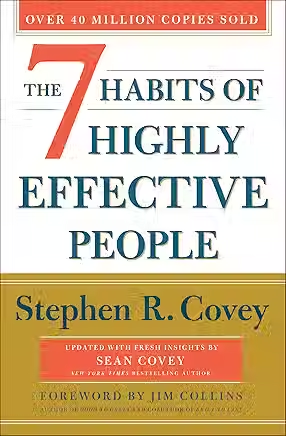
The 7 Habits of Highly Effective People is a deeply structured and principle-centered approach to personal and professional effectiveness that has shaped modern thinking about productivity, leadership, and character development for decades. Written by Stephen R. Covey, the book goes far beyond time management or motivational advice, instead offering a complete framework for living and working with integrity, intention, and long-term clarity.
At the foundation of Covey’s philosophy is the belief that effectiveness is rooted in character rather than personality techniques. He argues that many people focus on surface-level strategies for success—communication tricks, productivity hacks, or short-term motivation—while neglecting the deeper habits that shape behavior over time. The book is designed to shift that focus toward internal principles that guide consistent, values-based action.
The first part of the book introduces the concept of “private victory,” which includes the first three habits. Being proactive is presented as the starting point of personal responsibility, emphasizing the idea that individuals are not defined by their circumstances but by their responses to them. Covey expands this with “begin with the end in mind,” encouraging readers to define a clear sense of purpose and direction before making decisions. The third habit, “put first things first,” builds on this by focusing on prioritization, teaching readers to organize their lives around what is most important rather than what feels most urgent.
These early habits are presented as foundational because they develop self-mastery. Covey emphasizes that without this internal discipline, attempts to improve relationships, leadership, or productivity will be inconsistent or reactive. This section of the book is particularly focused on mindset shifts, helping readers move from reactive behavior to intentional living.
The second section focuses on “public victory,” which addresses how individuals interact with others. Covey introduces “think win-win” as a guiding principle for relationships, encouraging cooperation rather than competition. He frames success in relationships as something that should benefit all parties involved rather than being a zero-sum outcome. This habit is closely tied to long-term trust and mutual respect.
The next habit, “seek first to understand, then to be understood,” is one of the most widely cited principles in the book. Covey emphasizes empathic listening as the foundation of effective communication, arguing that most people listen with the intent to reply rather than to understand. By shifting this focus, he suggests that communication becomes more meaningful and less reactive, leading to stronger relationships in both personal and professional contexts.
The habit of “synergize” builds on these ideas by focusing on collaboration and creative problem-solving. Covey defines synergy as the ability to create solutions that are better than what any individual could achieve alone. This principle highlights the value of diversity in perspective and the importance of open-minded cooperation.
The final habit, “sharpen the saw,” shifts attention to long-term sustainability. Covey presents personal renewal as essential in four areas: physical, mental, emotional, and spiritual. Rather than treating productivity as constant output, he frames it as something that requires ongoing restoration and balance. This habit ties the entire framework together by reinforcing the idea that effectiveness depends on continuous self-renewal.
One of the book’s strongest qualities is the way these habits form a coherent system rather than isolated ideas. Each habit builds logically on the previous one, creating a progression from personal responsibility to interpersonal effectiveness to long-term renewal. Covey’s use of examples, diagrams, and reflective exercises helps reinforce these concepts in a structured way that encourages application rather than passive reading.
Another major strength is the book’s emphasis on principle-centered living. Instead of offering quick fixes or situational strategies, Covey focuses on values such as integrity, honesty, empathy, and responsibility. This gives the book a sense of depth that allows its ideas to remain relevant across different contexts, whether in leadership, family life, or personal development.
The writing style is formal and methodical, often revisiting key concepts from multiple angles to reinforce understanding. While this repetition slows the pace in some sections, it also ensures that the principles are clearly absorbed and not treated as disposable advice. The structure reflects Covey’s intent to create lasting behavioral change rather than temporary motivation.
Another notable aspect is the book’s balance between personal development and interpersonal effectiveness. Many self-help books focus primarily on individual productivity or external success, but Covey integrates both internal discipline and relational responsibility into a single framework. This makes the book particularly relevant for readers interested in leadership, management, or long-term personal growth.
By the end of the book, the central message becomes clear: true effectiveness is not achieved through isolated habits or quick improvements, but through a consistent alignment between values, behavior, and relationships. Living with intention, prioritizing what matters most, and engaging others with empathy and integrity form the foundation of a meaningful and effective life.


Comments