


Review: Ender's Game by Orson Scott Card

*As an Amazon affiliate I earn from qualifying purchases.
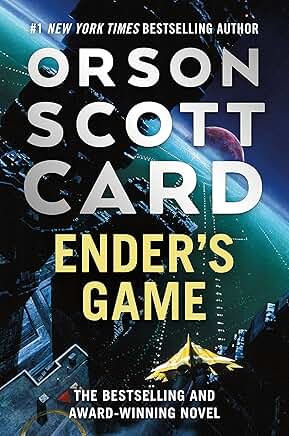
Ender’s Game by Orson Scott Card is a layered military science fiction novel that follows Andrew “Ender” Wiggin, a gifted child selected for an elite space academy designed to train humanity’s future commanders in preparation for a potential alien invasion by the Formics.
One of the novel’s most striking elements is its premise: children are recruited and trained as military strategists because of their perceived adaptability and creative thinking. The Battle School is presented as a rigorous environment of competition, surveillance, and psychological pressure, where games and simulations are designed not only to teach tactics but to reveal character, leadership potential, and emotional resilience under stress.
Ender Wiggin stands at the center of the story as a highly intelligent, deeply empathetic child whose abilities set him apart from his peers. What makes him compelling is not only his strategic brilliance but his emotional sensitivity, which repeatedly causes him distress as he is forced into increasingly harsh situations. His reluctance to harm others contrasts sharply with the system’s expectation that he become an efficient, decisive military leader.
A major theme of the novel is psychological manipulation. The adults overseeing Ender’s training—particularly Colonel Graff and the other instructors—carefully engineer scenarios to isolate him, provoke conflict, and push him beyond perceived limits. They justify their actions as necessary for humanity’s survival, but the ethical implications of their methods remain deeply troubling throughout the narrative.
The Battle School sequences are structured around increasingly complex zero-gravity combat simulations, known as “battles,” which require coordination, spatial reasoning, and rapid decision-making. These scenes are among the most dynamic in the novel, illustrating Ender’s growing tactical genius as he learns to anticipate patterns, exploit weaknesses, and redefine conventional approaches to combat strategy.
Ender’s isolation is one of the most persistent emotional threads in the story. Despite being surrounded by other exceptionally talented children, he is frequently separated, either physically or psychologically, from meaningful peer relationships. This isolation is not incidental but deliberately engineered by his superiors, who believe that loneliness fosters independence and innovation in leadership.
His relationships with his siblings, Valentine and Peter Wiggin, add additional psychological depth. Valentine represents empathy, moral reflection, and emotional grounding, while Peter embodies ambition, manipulation, and cruelty. Ender’s internal struggle can be seen as a synthesis of these opposing forces, raising questions about how personality is shaped by environment versus innate disposition.
Another important aspect of the novel is its exploration of empathy as both a strength and a vulnerability. Ender’s ability to understand his opponents’ perspectives allows him to become an exceptional strategist, but it also causes him emotional suffering when he recognizes the humanity of those he must defeat. This tension becomes central to the novel’s ethical framework.
Orson Scott Card’s writing style is clear, fast-paced, and focused on psychological and tactical detail. The narrative alternates between intense action sequences and quieter introspective moments, allowing readers to engage with both the external challenges of training and the internal consequences of Ender’s experiences.
As the story progresses, the line between simulation and reality becomes increasingly blurred. What begins as structured training exercises gradually takes on far greater consequences, culminating in a revelation that reframes Ender’s entire experience and forces him to confront the true cost of his success. This structural shift is one of the novel’s most impactful elements, reinforcing its critique of detached military systems.
A key theme throughout the novel is the moral ambiguity of leadership preparation. The adults’ willingness to sacrifice a child’s psychological well-being for strategic advantage raises uncomfortable questions about utilitarian ethics and the limits of authority in times of existential threat. The novel does not offer simple answers, instead presenting the tension between necessity and morality as unresolved.
The depiction of future warfare also emphasizes intelligence over brute force. Battles are won through anticipation, adaptability, and psychological insight rather than sheer power, reflecting a broader shift in science fiction toward cognitive and strategic conflict.
At times, the emotional intensity of Ender’s experiences can feel overwhelming, particularly as his isolation deepens and the manipulation intensifies. However, this intensity is central to the novel’s impact, reinforcing the psychological cost of shaping individuals into instruments of war.
Ender’s Game stands as a powerful exploration of genius, manipulation, and moral consequence. Through Ender Wiggin’s journey from isolated child to strategic prodigy, Orson Scott Card creates a narrative that challenges readers to consider the ethical boundaries of leadership training, the cost of victory, and the human consequences of treating empathy as both a tool and a liability.


Comments