


Review: Your Money or Your Life: 9 Steps to Transforming Your Relationship with Money and Achieving Financial Freedom by Vicki Robin and Joe Dominguez

*As an Amazon affiliate I earn from qualifying purchases.
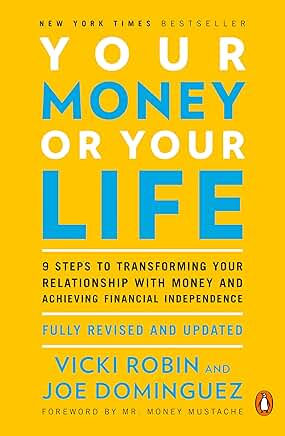
Your Money or Your Life: 9 Steps to Transforming Your Relationship with Money and Achieving Financial Independence is a foundational personal finance book that challenges readers to rethink their entire relationship with money, work, and consumption. Written by Vicki Robin and Joe Dominguez, the book goes beyond budgeting advice and instead asks a more fundamental question: what is money actually costing you in terms of your time, energy, and life?
At the center of the book is the idea that money is not just currency, but “life energy.” The authors encourage readers to calculate how many hours of work are required to earn money and then evaluate whether purchases are truly worth the time spent earning them. This reframing shifts financial decisions from abstract numbers to something more personal and tangible—your limited time on earth.
One of the book’s most influential contributions is its step-by-step program for transforming financial habits. It guides readers through tracking every dollar they earn and spend, calculating their real hourly wage, and gradually aligning spending with personal values. This process is designed not just to reduce debt or increase savings, but to create a deeper sense of financial awareness and intentionality.
A major theme throughout the book is sufficiency—knowing when enough is enough. The authors argue that modern consumer culture often encourages constant growth in spending and consumption, which can lead to financial stress and dissatisfaction. Instead, they promote a lifestyle where financial independence is achieved not by earning more endlessly, but by defining what is truly necessary and eliminating excess.
Another key concept is the “crossover point,” where investment income eventually covers living expenses, allowing for financial independence or early retirement. While this idea has influenced many modern FIRE (Financial Independence, Retire Early) movements, the book’s focus is less on wealth accumulation and more on aligning money with personal values and life purpose.
The tone of the book is reflective and instructive, often combining practical exercises with philosophical reflection. It encourages readers to examine emotional and cultural assumptions about money—such as equating success with income or consumption—and to consider alternative definitions of a “rich” life.
One of the book’s strengths is its holistic approach. It does not isolate finance from lifestyle, psychology, or ethics. Instead, it presents money as deeply connected to well-being, time management, and personal fulfillment. This makes it especially appealing to readers who feel disconnected from traditional financial advice that focuses solely on earning and investing.
However, the book’s methodology can feel demanding. The tracking exercises and detailed accounting of spending require consistent discipline, which some readers may find overwhelming or time-consuming. Additionally, while its principles are widely influential, some of its examples and economic assumptions reflect the time in which it was written and may feel slightly dated in today’s digital economy.
Even so, Your Money or Your Life remains one of the most impactful personal finance books because it reframes the entire conversation around money. It is less about getting rich quickly and more about understanding what wealth actually means in terms of lived experience.
The book leaves readers with a powerful shift in perspective: financial decisions are ultimately life decisions, and true wealth is measured not just in dollars, but in the freedom to spend your time in ways that feel meaningful and aligned with your values.


Comments