


Review: The Adventures of Sherlock Holmes by Arthur Conan Doyle

*As an Amazon affiliate I earn from qualifying purchases.
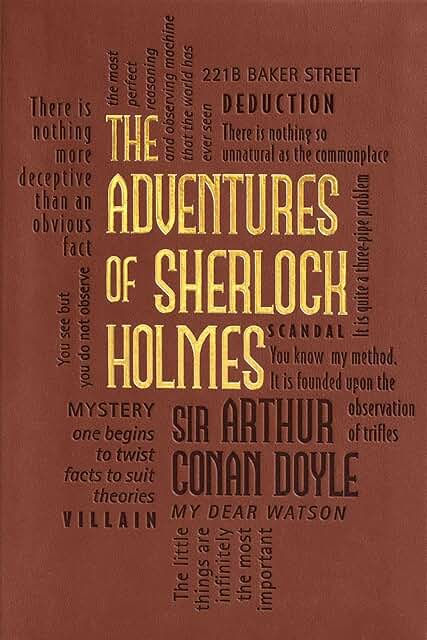
The Adventures of Sherlock Holmes by Arthur Conan Doyle is a landmark collection of detective stories that helped define the modern mystery genre. First published in the late 19th century, the collection follows the brilliant consulting detective Sherlock Holmes and his companion Dr. John Watson as they investigate a series of puzzling cases in Victorian London and beyond.
One of the most defining strengths of the collection is the character of Sherlock Holmes himself. Holmes is portrayed as intensely observant, highly logical, and often emotionally detached, relying on deduction rather than intuition or sentiment. His ability to notice minute details and draw sweeping conclusions from them gives the stories their intellectual appeal, turning each case into a puzzle for both Holmes and the reader to solve.
Dr. Watson plays a crucial role as narrator and grounding presence. Through his perspective, the reader experiences both admiration and occasional confusion at Holmes’s extraordinary reasoning. Watson’s more human, empathetic viewpoint balances Holmes’s analytical nature, making the stories accessible and emotionally engaging while also emphasizing the brilliance of Holmes’s methods.
The cases themselves vary in tone and complexity, ranging from thefts and disappearances to more intricate mysteries involving disguise, blackmail, and hidden identities. Each story is structured around a central problem that appears unsolvable until Holmes applies his method of observation, deduction, and logical reconstruction of events. This formula creates a consistent sense of intellectual satisfaction throughout the collection.
Victorian London serves as a vivid and atmospheric backdrop. The city is portrayed as both sophisticated and shadowy, filled with fog, social inequality, and hidden criminal activity. This environment reinforces the tone of mystery and uncertainty, making it an ideal setting for Holmes’s investigative work.
A central theme of the collection is rationality versus assumption. Holmes consistently challenges surface-level interpretations of events, demonstrating that truth often lies beneath appearances. His methods emphasize careful observation and logical reasoning, contrasting with the more emotional or instinctive reactions of other characters, including police officials.
Arthur Conan Doyle’s writing style is clear and efficient, focusing on plot progression and dialogue rather than elaborate description. This allows the mysteries to remain central while still providing enough detail to create atmosphere and tension. The pacing of each story is designed to build curiosity and then deliver a satisfying explanation through Holmes’s final deductions.
Many of the stories also explore human motivation—jealousy, greed, love, and revenge—showing that even the most puzzling crimes often stem from deeply human emotions. This grounding in human behavior helps balance the intellectual nature of the detective work with emotional realism.
At times, the episodic structure means that character development is subtle rather than continuous, but this format suits the short-story nature of the collection. Each case functions as a self-contained exploration of mystery and logic, while gradually building a broader sense of Holmes and Watson’s partnership.
The Adventures of Sherlock Holmes remains one of the most influential works in detective fiction. Through its memorable characters, carefully constructed mysteries, and emphasis on logic and observation, Arthur Conan Doyle creates a collection that continues to shape how mystery stories are told and understood.


Comments